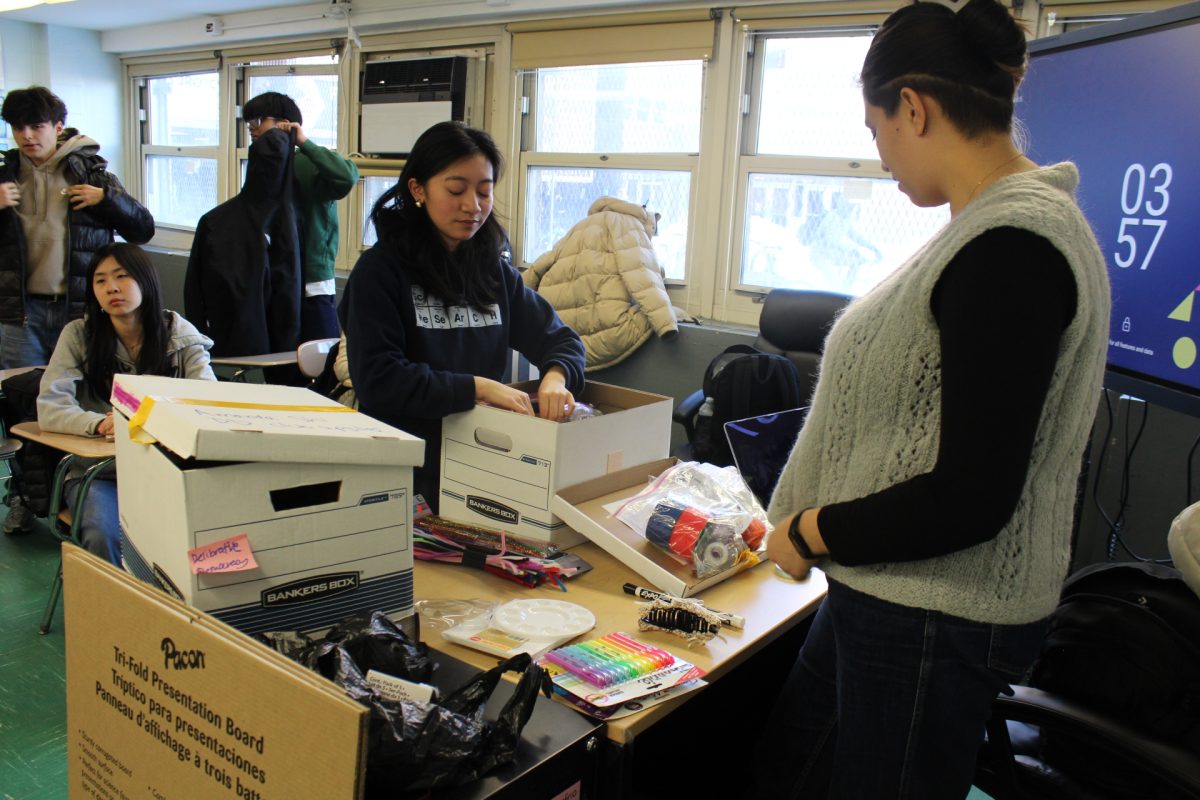
New York’s new class size legislation aims to cap classrooms at 25 students, a welcome change for many. But for schools like Francis Lewis High School, which serves nearly 5,000 students, implementing this change presents daunting challenges. With there being 34 students in a class with only one teacher and 45 minutes on the clock, many students struggle to grasp the material or find the time to comfortably ask questions. As schools continue to get overcrowded, New York State Governor Kathy Hochul signed a new education bill into act in September 2022, mandating the resizement of classrooms over a span of 5 years beginning in September 2023 (New York City Independent Budget Office). Despite the research supporting the benefits of a smaller class on student education, the rapid implementation of this law, particularly at large schools like Francis Lewis, could have significant repercussions for New York’s education system.
“At the moment, I am not in favor of the law being implemented the way it is written,” Dr. Marmor, Principal of Francis Lewis High School commented. “I want to reiterate that I’m not against smaller classes, it is just not practical until there is additional capacity built.”
Dr. Marmor further elaborated that “the problem at overcrowded schools, most of the schools in Queens and Southern Brooklyn, is going to become a crisis that the parents and the students won’t realize until they’re denied entry” to even their zoned school.
“To fix the problem in Queens, they would need to build dozens of more schools,” Dr. Marmor further elaborates. “But with the law taking full effect within four years, the city is physically not ready and while the politicians argue about whose fault it is, the students, the schools, and the parents are the ones who are gonna get hurt.”
The issue doesn’t just lie with the new law itself but with the inevitable changes it would make to the student body and the number of students schools like Francis Lewis are able to admit.
“We don’t have enough space to add more classes,” Dr. Marmor describes. “We would have to reduce our enrollment by as much as 1200 or more students. In the future 10% to 20% of Francis Lewis zoned kids will also get denied.”
Nonetheless, many students would appreciate the opportunity of improving their education by attending a school environment with smaller classes.
“Personally, I value quality a lot more,” Victoria Qu, Francis Lewis senior stated. “I would give up the opportunity to be in Francis Lewis if it meant that we would have smaller class sizes. I would rather be in a school with fewer students and more teachers because I could get a lot more help.”
Many support the belief that being in an extensive class environment result in students falling behind or going by unnoticed, damaging their opportunity to receive the best education possible.
“I have a wonderful student but she’s the very quiet, off the radar type of kid and I found out that her mom just passed away and I’m sitting here thinking I didn’t even realize that her mom was sick and what she was going through,” Ms Wattoo, United Federation of Teachers (UFT) representative and teacher described. “If I knew I would’ve done more; that kind of relationship with the students is so limited because there’s so many of you. Even though having 170 students and having 125 students doesn’t sound like a big difference, it is ’cause at least we are able to focus more on the emotional wellbeing of the child.”
On the other hand, some students feel more comfortable in a larger school environment as it provides them with a wider range of student interactions, extracurriculars, and opportunities.
“Even with the benefits of a smaller school, it meant that there was less opportunity and less programs,” Malak Abukoush, junior at Francis Lewis stated. “I really love talking to a variety of people, interacting with different backgrounds, and being in a bigger setting, it’s more of where I thrive and grow.”
With endless opportunities available at larger schools, students at Francis Lewis gain access to a diverse selection of pre-professional and elective programs. However, these opportunities are bound to be disintegrated due to the new law, ultimately decreasing students’ career-orientated exposure during high school.
“It’s gonna happen in the arts, it’s gonna happen in music,” Dr. Marmor exclaims. “You can think about it this way, if you need more algebra classes, the teachers that used to teach computer science are now gonna teach algebra. The expansion of the core courses is going to reduce the space and availability for electives and AP courses and all the other things that make a really rich high school experience.
Shirley Aubin, the PTA President believes that high schools should “have clubs, sports, course electives, to increase and enhance interests and passions, and create opportunities for students to explore their skills and their talents”, opportunities that may well be lost otherwise.
“We have a robotics program, which has a special room with special machinery, where you have 340 kids, theoretically, that can take robotics”, Dr. Marmor comments. “The day after this law is implemented, 90 kids in our building will lose that ability.
“Someone who’s not really understanding how schools run could just say, we’ll put ’em in another robotics class,” Dr. Marmor further elaborates. “That doesn’t exist. We spent over a hundred thousand dollars building the room, we don’t have space or more money. Lost electives, lost APs, reduced opportunities for children are a fact that’s gonna happen with this law.”
Nonetheless, Ms. Wattoo believes that it is more important “if the students are happy and they like their teacher. Teachers as well will have something that’s more manageable and they’ll be happier and have more time for their students.”
“I don’t think that having a kid take 20 honors classes is good,” Ms. Wattoo explains. “They don’t have to worry about taking this AP, that honors, this honors. If it’s not offered, less responsibility and you can focus on being a kid because at the end of the day, this is just high school, you have the rest of your life ahead of you.”
Apart from the loss of electives and rigorous academic programs, the law’s implementation will inevitably result in the rise of equity issues. Dr Marmor commented how it’s “going to draw away a very large number of experienced teachers from the hard to staff schools leaving a major deficit of quality teaching.”
“The analysis right now is that the harder to staff districts, where you have kids in the most academic need, already have the smallest class sizes while the schools that are the most overcrowded are performing the highest,” Dr. Marmor explains. “In order to comply with the law, the city is gonna have to pour enormous amounts of extra money into the schools that are already successful and already easier to staff, taking away money from the schools with greater needs just to comply with the law.”
With the ongoing teacher shortage combined with a rapid increase in the need for quality educators, the implementation weighs heavily on the lack of teachers, even with current efforts to mitigate the issue.
“I know each of the high school districts in the borough have been doing hiring pushes, hiring fairs over and over so they understand that we need teachers now,” Shirley elaborates. “Getting people to apply and have qualified teachers is a whole different thing. Schools can’t be full of all new teachers, as wonderful, bright and brilliant they may be, you need veterans that know the system and give support and mentorship to the new people.
Although the teacher shortage has proven to become a challenge, it also provides an opportunity for more educators to be hired within the school communities. Students have the opportunity to get more personalized attention while teachers have greater chances of getting hired.
“I think it would be a good thing to incorporate a smaller class because I feel like a lot of students who are trying to get into the teaching field as of now, they’re having a hard time finding jobs after graduating from college,” Qu commented. “I would say childcare is a hard career field to be in because you can’t really get a job unless a teacher retires so by making the classes smaller it would definitely give us a little more opportunity in the world and help the economy.”
With the wide array of onset problems that must be addressed prior to successfully implementing the law, the current plan is extremely vague. Due to the enormity of Francis Lewis, there is no physical way the school can comply within the given time frame and therefore, is in need of a waiver. Waivers are issued “for those who have specific issues and cannot wait 20 years to implement the small class sizes,” as Shirley explained.
“The current plan is ineffective to properly implement ’cause it doesn’t give clear guidance to what exactly needs to be done in different circumstances,” Shirley explained. “It’s not detailed and clear guidance on how to get to smaller class sizes is needed. They need to have actual steps that’s going to be done and it’s gonna vary from school to school.”
Many have brought up and attempted to take action to address concerns regarding the implementation of this law as it currently stands, seeing multiple issues that have yet to be resolved as huge potential conflicts in the future.
“At the end of the day, this law needs more thoughtful planning,” said Dr. Marmor. “We need solutions that work for everyone – students, teachers, and schools alike.”