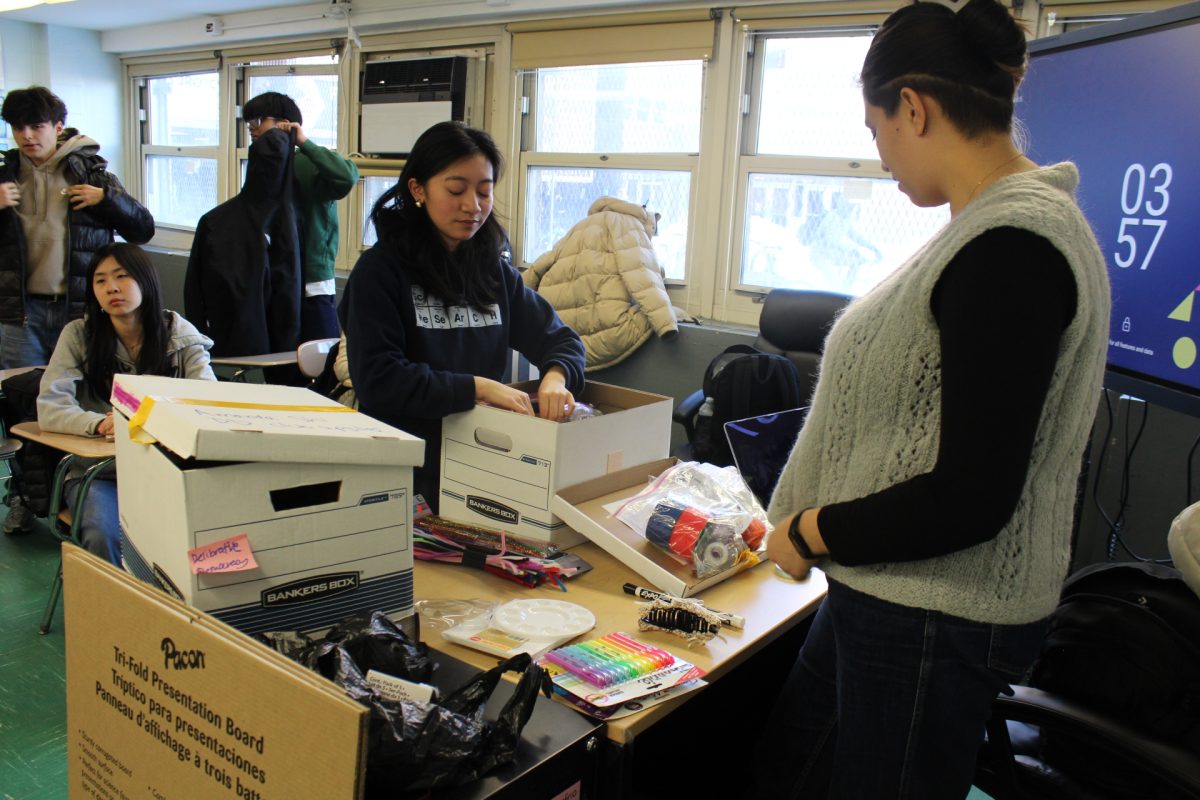
At the beginning of the school year the Office of School Foods proposed a challenge to Francis Lewis’s own culinary academy: create a new dish to be served in all New York City (NYC) K-12 schools. Throughout the process, culinary students formed eight groups in order to craft unique recipes, test different foods, adhere to nutritional guidelines and even visit the department’s facilities. The students experienced challenges and obstacles as they learned through trial and error as they crafted their new dishes.

“No other culinary school has ever done this before,” Chef Neil Syham. We are the pioneers, the first school to ever do this and it’s a really big thing for our school and for the culinary program.”
To tackle this task, the culinary students were given weekly challenges that pushed them to test their creativity and follow the guidelines of the NYC Department of Education (DOE).
“The trials were difficult because with those two ingredients, we had to alternate every week between chicken and beans,” recounts junior and culinary student Kaiji Chen. “So on the beans days, it was really hard to find a recipe that we could do because beans are not the greatest.”
Nonetheless, the students were not just challenged by the limited ingredients but by the wide variety of aspects that play into a full meal including the seasonings and ensuring that all nutritional components were met.
“I feel like it’s a challenge because you think everything needs salt, everything needs sugar, everything needs protein, like chicken or beef,” describes junior culinary student Apostolia Kyriacou. “My team struggled at first creating something because we were thinking inside the box but once we looked at recipes, it became much easier.”
In addition to the weekly challenges that students participated in, they also visited the Office of Food and Nutrition Sciences (OFNS) in Long Island City on October 10th, 2024 to gain a better understanding of the city’s process of creating school wide school food. Throughout this trip, students tried various school foods that were in production and learned about product development from two chefs at the OFNS.
“I found it challenging for what their job is and I think it helped us to realize what we have to go through to also create a new recipe,” exclaimed Wong. “Also it helped us with a little bit of creativity ’cause of the foods that we tried.”
“We went there and the food that we tried was actually really good so that kind of inspired us to feel like we could actually do it and make it taste good,” adds junior and one of the winners of the competition, Max Fong. “They offered a lot of different recipes that aren’t offered in schools yet and they were really different, and we were inspired by it.”
While the culinary students resonate with the displease of other students with school food, they believe that this challenge gave them the ability to provide their fellow peers with meals that they would actually enjoy.
“I feel like this is a really big opportunity because I feel that the school meals can improve,” expressed junior Olivia Wong. “A lot of kids would eat a bite and they wouldn’t like it ’cause of the taste. It’s a good opportunity for us to create a recipe that kids will actually eat without wasting food.”
Chef Syham explains that throughout the process, the culinary students had to follow DOE’s food guidelines for school meals which proved to be extremely difficult due to the “low fat, low sugar, low salt content” requirements.
“The one setback would be having to match the salt and sugar levels to what it has to be because no matter what you do, pre-made foods, like let’s say canned tomatoes have salt in them, they have preservatives in them, they have sugars in them. You have to really dissect it and break down recipes to make them somewhat okay for DOE levels. That’s why it’s a setback that you kind of have to stay away from salt.”
In order to adhere to the restrictions placed upon the challenge when it comes to salt, sugar and fat levels, the culinary students needed to get creative with their seasoning profiles and ingredient substitutes to still provide a delicious and quality meal.
“I think it helped us learn how to compromise because salt is obviously the main ingredient in making food more tasty, but we had to use less salt or no salt at all,” explains Fong. “It made us learn how to compromise by using other ingredients for supplements.”
We try to go towards seasonings that don’t include salt or sugars that aren’t sugar, like honey,” Kyriacou further explains. “We’re allowed to use honey ’cause it’s natural or using things like apples to sweeten our foods.
The culinary students had to get creative with certain substitutes while also ensuring that taste wasn’t altered.
“We try to find alternatives to that fat or salt like for heavy cream, we try to limit that,” Wong further adds. “There was one recipe that called for yogurt but instead we used lemon and milk, which helped with the taste.”
On May 29th, 2025, Francis Lewis held a tasting event in the school cafeteria open to all the students to invite them to rate and review the winning recipe of the competition: the honey garlic chicken. This dish was inspired by Asian cuisine and consisted of chicken pieces coated in a honey, garlic, and soy sauce glaze that was paired with fresh steamed broccoli and fresh bell peppers.
“We wanted to find a cuisine or culture that a lot of people would resonate with,” explains Fong. “One of the main things that we thought everybody liked was Chinese food, but the main issue with Chinese food is that it’s way too unhealthy. They use a lot of MSG and stuff, so we wanted to find a flavor that would mimic that type of culture but also still be healthy enough for school food.”
While the winners tried to hone into Asian roots for the dish, some students felt that the dish was too nostalgic for their taste.
“It tastes like something my grandma would make,” commented Francis Lewis senior Chris Ferng. “I’m gonna be honest, I’m not like not a fan of home cooking.”
“I think it can be seasoned a little more, it kind of tastes like fish to me in some way,” sophomore Kaity Cheng adds. “It needs a little more salt ’cause I’d taste the honey, but not the salt.”
Despite the feedback of some students at the tasting event, the survey results showcased that 59.4% of the students at the tasting event found the dish to be good and 52.5% of the students rated it as well-balanced.
“The honey garlic chicken was kind of good, it’s better than most school food that I’ve ate,” describes senior Jason Ho. Since the school has some regulations, they can’t make it as tasteful as they would’ve, but I say that this is still better than most food like the veggie nuggets and potato wedges, so I’d say this is up there.”
As the chicken dish was appreciated by the Francis Lewis community, the creators of the dish- juniors Max Fong, Renee Mok, Sean Choi, Kaijie Chen, and Sushant “Skippy” Jeythas felt like they made a great contribution to lunchrooms citywide with their “simple yet delicious” motto.
“I think we actually made an impact,” expressed Chen. “We added an idea that students can also change the school cafeteria menu by implementing delicious and simple dishes that students will enjoy.”